

You glance at your wrist, and the second hand ticks forward in steady, precise beats. It never wavers. It never needs winding. Day after day, it simply keeps perfect time. Behind that quiet reliability sits one of the most elegant feats of modern watchmaking, and most people wear it without ever knowing what makes it work.
The answer lives inside the movement, the tiny engine that powers every watch. Quartz movements transformed the industry decades ago, bringing accuracy and ease to timepieces at every level. Understanding how they function gives you a deeper appreciation for the watch on your wrist and a sharper eye when you shop for your next one.
By the end of this guide, you will know exactly how a quartz watch works, what sets it apart from other movements, and why it remains a favorite among collectors and everyday wearers alike. Let us open the case and look inside.
The Heart of the Matter: What Powers a Quartz Watch Movement

At the center of every quartz timepiece is a small piece of quartz crystal, the same mineral found throughout the earth. This crystal is the reason the watch keeps such reliable time. When you understand its role, the rest of the quartz watch movement becomes simple to follow.
A quartz watch runs on a battery rather than a wound spring or the motion of your wrist. The battery sends an electric current through the quartz crystal, which has been cut into a precise shape, often resembling a tiny tuning fork. This is where the magic begins.
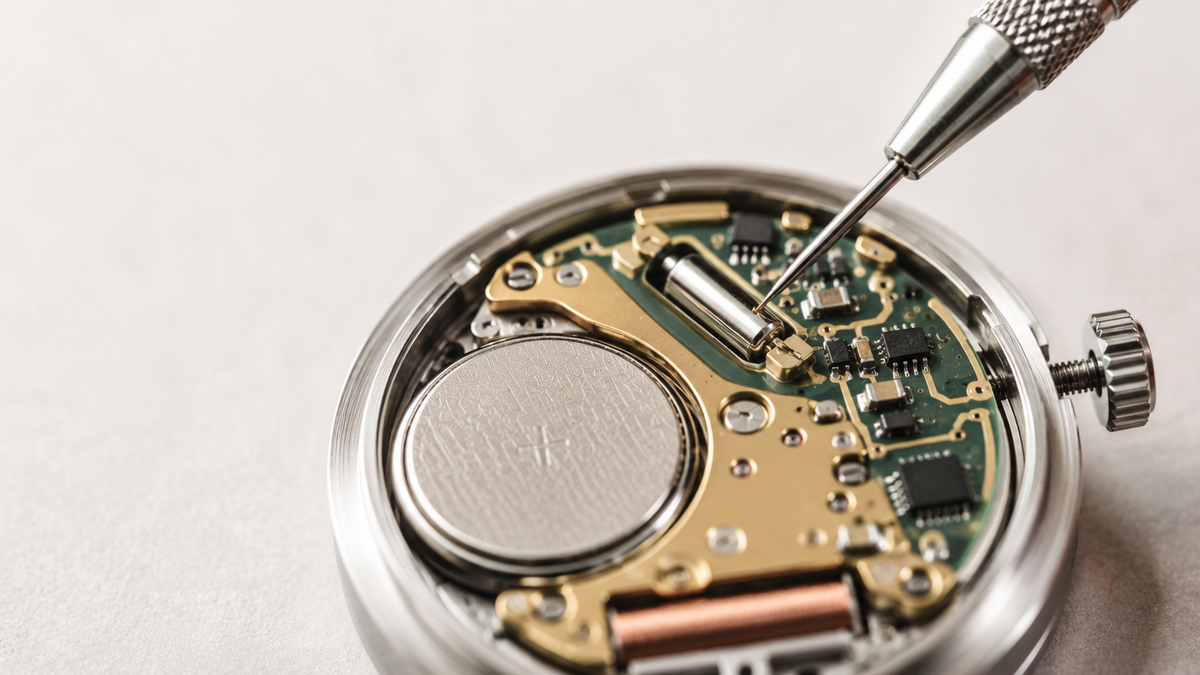
At its core, a quartz movement relies on just a few essential parts working in harmony:
- The battery, which supplies a steady source of electrical power
- The quartz crystal, which vibrates at a precise frequency when charged
- The integrated circuit, which counts those vibrations and regulates timing
- The stepping motor, which converts electrical pulses into mechanical motion
- The gear train and hands, which display the time on the dial
The crystal responds to that electric current in a remarkable way. It vibrates, and it does so with extraordinary consistency, holding a steady rhythm that becomes the foundation for accurate timekeeping.
How the Quartz Crystal Keeps Time

Here is the elegant part. When electricity passes through quartz, the crystal vibrates at a precise and predictable frequency: exactly 32,768 times per second. This property is known as the piezoelectric effect, the tendency of certain crystals to generate a steady oscillation when met with an electric charge.
- The path from electricity to accurate time follows a simple, repeating sequence:
- The battery sends current to the quartz crystal.
- The crystal vibrates 32,768 times every second.
- The circuit counts those vibrations and registers one full second.
- The circuit sends an electrical pulse to the stepping motor.
- The motor advances the gears, and the gears move the hands forward.
This entire sequence repeats silently, every second of every day, which is why a quartz watch ticks with such steady confidence.
Are Quartz Watches Accurate? What the Numbers Say
If precision matters to you, this is welcome news. Are quartz watches accurate? Remarkably so. Because the quartz crystal vibrates at such a stable frequency, a standard quartz watch typically stays within 15 to 30 seconds of error per month.
Compare that to a mechanical watch, which relies on a network of springs and gears and may gain or lose several seconds each day. Quartz technology simply offers a level of consistency that traditional movements find difficult to match.
This accuracy comes from physics rather than craftsmanship alone. The crystal does not care whether you wore the watch yesterday or left it in a drawer for a week. When you pick it up, it keeps the same faithful time, which makes quartz a practical choice for collectors who rotate many pieces. You will find dependable quartz options among our pre-owned and vintage timepieces, where quality and value meet.
Quartz vs Mechanical: Understanding the Difference

People often weigh quartz against mechanical movements, and each has its own appeal. A mechanical watch is powered by a tightly wound mainspring and a series of intricate moving parts. Many collectors treasure these timepieces for their artistry and their connection to centuries of watchmaking tradition.
A quartz watch, by contrast, prizes precision and low maintenance. It does not need winding, it rarely requires adjustment, and it asks little of you beyond an occasional battery change. For everyday wear, that ease is hard to beat.
The table below breaks down how the two movements compare across the qualities that matter most:
|
Feature |
Quartz Movement |
Mechanical Movement |
|
Power source |
Battery |
Wound mainspring |
|
Typical accuracy |
15 to 30 seconds per month |
Several seconds per day |
|
Maintenance |
Battery change every 1 to 3 years |
Regular winding and periodic service |
|
Moving parts |
Fewer |
Many intricate components |
|
Winding required |
No |
Yes, manual or automatic |
|
Best suited for |
Everyday precision and convenience |
Craftsmanship and tradition |
Neither movement is better in every situation. The right choice depends on what you value: the soul and heritage of mechanical craftsmanship, or the accuracy and convenience of quartz. Brands such as Seiko helped pioneer quartz technology, and their work shaped the modern watch landscape in lasting ways.
Caring for Your Quartz Watch and Its Battery

A quartz watch asks very little, yet a few simple habits keep it running beautifully for years. The most important is attention to the quartz watch battery, which typically lasts between one and three years depending on the movement and features.
A few simple practices will keep your timepiece in excellent condition:
- Replace the battery promptly when the second hand begins to skip or stall, since a drained battery can leak and damage the movement.
- Choose a qualified watchmaker over a kiosk, so the case is resealed correctly and water resistance is preserved.
- Service the watch periodically to keep the movement clean and running smoothly.
- Store it safely when not in wear, away from extreme heat, moisture, and strong magnets.
For a luxury timepiece, this small investment of care protects both the function and the long-term value of your watch.
A Small Crystal, A Lasting Impression
The next time your watch ticks forward, you will know the quiet story behind it: a sliver of quartz vibrating thousands of times each second, counted and translated into the steady motion on your wrist. It is precision born from a simple, beautiful piece of nature.
Whether you are drawn to the reliable ease of quartz or the timeless craft of a mechanical piece, the right watch is the one that speaks to you. Our team is always happy to help you find it. Reach out to us to begin the conversation.
Frequently Asked Questions
How long does a quartz watch last?
A well-made quartz watch can last for decades with proper care. The movement itself is durable and low maintenance, and the main upkeep involves replacing the battery every one to three years and having the watch serviced periodically by a professional.
Do quartz watches need to be wound?
No, quartz watches do not need winding. They draw their power from a battery rather than a wound mainspring, which is one of the key conveniences that sets them apart from mechanical timepieces.
How often should I replace a quartz watch battery?
Most quartz watch batteries last between one and three years, though this varies with the movement and the watch's features. When you notice the second hand skipping or stopping, it is time to have the battery replaced by a qualified watchmaker.
Are quartz watches more accurate than automatic watches?
In most cases, yes. A quartz watch typically stays within 15 to 30 seconds per month, while an automatic watch may gain or lose several seconds each day. Quartz movements rely on the steady vibration of a crystal, which gives them an edge in precision.
Can a quartz watch be a luxury timepiece?
Absolutely. Many prestigious brands produce high-end quartz watches that combine fine materials, expert finishing, and precise movements. Quartz technology is found in everything from everyday watches to refined luxury pieces.