

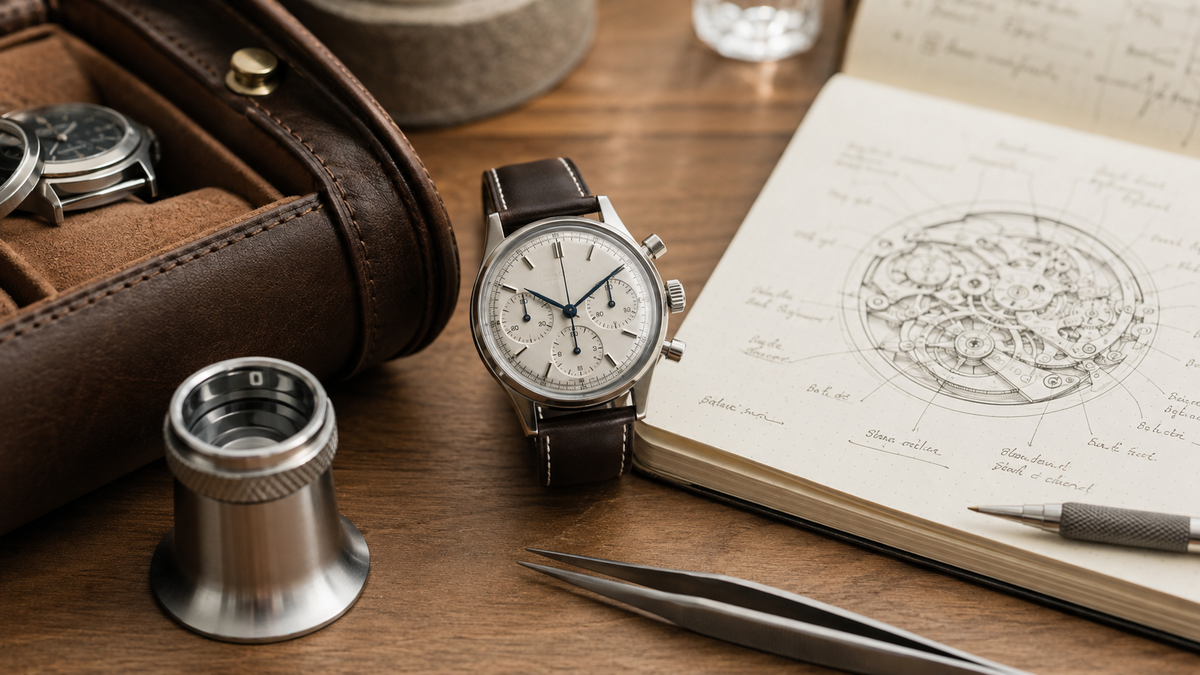
You glance down at a handsome dial and notice three smaller circles staring back at you, plus two pushers flanking the crown. Most owners wear a watch like this for years without ever touching those buttons.
Understanding how a chronograph watch works turns a beautiful object into a genuinely useful instrument. At its heart, a chronograph is a stopwatch built into a wristwatch: the timekeeping side runs continuously while a separate mechanism measures elapsed intervals on command.
Here is what each subdial measures, how to operate the pushers correctly, and how to keep the mechanism healthy for decades. Browse our latest arrivals in luxury timepieces alongside this read.
What Is a Chronograph Watch and Why Collectors Prize It

The name comes from the Greek chronos, meaning time, and graph, meaning to write. Three features define the complication:
- A running seconds display, usually tucked into a small subdial
- A central sweeping hand that sits still until you start it
- Pushers on the case flank that start, stop, and reset the measurement
That stillness is the giveaway. A chronograph also demands dozens of extra components and precise finishing, which is why it remains one of the clearest demonstrations of a house's technical fluency.
How a Chronograph Watch Works Inside the Case

The base movement powers the hours, minutes, and running seconds. The chronograph module sits on top, dormant until engaged.
Press the upper pusher and a lever engages a clutch that connects the mechanism to the running gear train. Press again and the clutch disengages, freezing the hands. The lower pusher trips heart-shaped cams called hammers, snapping every chronograph hand back to zero.
|
Design element |
Cam-actuated |
Column wheel |
|
Pusher feel |
Firmer, more resistant |
Crisp and light |
|
Cost |
Lower |
Higher |
|
Found in |
Accessible models |
Haute horlogerie |
Clutch type matters too. A horizontal clutch meshes gears sideways, giving a slight charming stutter at start. A vertical clutch presses discs together for an instant start and handles long running periods better.
Chronograph Subdials Explained: What Each Register Measures

The subdials, properly called registers, are not decorative.
|
Position |
Measures |
Runs constantly? |
|
Nine o'clock |
Running seconds |
Yes |
|
Three o'clock |
Elapsed minutes, up to 30 |
Only when running |
|
Six o'clock |
Elapsed hours, up to 12 |
Only when running |
Layouts vary. Some houses place running seconds at six o'clock; bicompax dials use only two registers. The Omega collection shows how one manufacturer has refined placement across generations. To identify your own layout, find the subdial that never stops. That is always your running seconds.
How to Use a Chronograph Watch Without Damaging It
- Press the top pusher to start
- Press the top pusher again to stop and hold the reading
- Press the bottom pusher to reset to zero
What to avoid:
- Never reset while running. This can bend or shear a lever.
- Avoid pressing pushers underwater. Those gaskets are the weakest point in the case.
- Do not leave it running indefinitely on a horizontal-clutch caliber.
One exception: a flyback chronograph resets and restarts with a single press. Unless yours is a flyback, treat the sequence above as non-negotiable.
How to Read a Chronograph and Use the Tachymeter Scale

Add the hour counter, the minute counter, and the center seconds hand together for your total elapsed time.
The outer ring is where things get clever. A tachymeter converts elapsed time into a rate per hour. Start the chronograph at a marker, stop it one mile later, and read where the hand points. That figure is your average speed. The same works for production output.
Other scales include the telemeter for distance, and the pulsometer for counting heartbeats. Zenith's chronograph heritage shows this lineage expressed beautifully on the dial.
Chronograph vs Chronometer: Two Words, Two Different Things

|
Chronograph |
Chronometer |
|
|
What it is |
A function |
A certification |
|
Awarded by |
Nobody, it is a feature |
An institute such as COSC |
|
Standard |
Not defined |
Roughly -4 to +6 seconds daily |
A watch can be both, one, or neither. Houses celebrated for chronometric rigor, such as precision-focused timepieces like Grand Seiko, push accuracy independent of complications. Our comparison of quartz and automatic movements and our guide to how a quartz watch works cover the mechanics underneath.
Wearing, Sizing, and Living With a Chronograph
Extra machinery means thicker cases, so a 40mm chronograph wears larger than a 40mm dress watch.
- Lug-to-lug distance matters more than diameter
- Case thickness determines cuff comfort
- Dial legibility suffers when registers crowd the layout
Our guide to understanding watch case size and fit walks through measuring properly. For daily care, keep the pushers free of grit and follow our method for cleaning a stainless steel watch strap.
Chronograph Watch Servicing and Why It Requires a Specialist
A chronograph module adds well over 100 components, each enduring friction a time-only caliber never sees. Signs service is due:
- Reset hands stop short of zero or overshoot
- The center hand stutters once started
- Pushers feel gritty or spongy
Most mechanical chronographs need a full service every five to seven years. Our overview of whether your watch needs regular servicing explains how intervals differ.
This is not work for a general repair counter. Our master watchmakers service these calibers regularly with manufacturer-specified lubricants and pressure-test every case. Our curated pre-owned timepieces receive the same evaluation before reaching the display case.
Bringing It All Together
Those extra dials were never ornamental. Each measures something specific, and once you understand how a chronograph watch works, you start using it.
Our team has spent more than 30 years helping collectors in Greenwich and New Canaan, CT find the right fit. Come see the collection in person, or schedule a consultation and we will walk you through it together.
Frequently Asked Questions
What do the three small dials on a chronograph watch do?
Typically one tracks the running seconds of the watch itself and never stops, while the other two count elapsed minutes and elapsed hours once you start the chronograph. Layouts vary between manufacturers, so identify the register that moves constantly to orient yourself. That one is always your running seconds.
Can you use a chronograph as a regular watch?
Absolutely. The chronograph function is entirely separate from timekeeping, so the watch keeps perfect time whether or not you ever touch the pushers. Many owners simply enjoy the dial's symmetry and use the stopwatch occasionally.
Is it bad to leave a chronograph running all the time?
On watches with a horizontal clutch, running the chronograph continuously increases wear on the meshing gear teeth and draws extra power from the mainspring. Vertical-clutch calibers handle extended use far better. When in doubt, stop and reset the chronograph once you are finished timing.
What is the difference between a chronograph and a chronometer?
A chronograph is a function, meaning the watch can measure elapsed time with pushers and counters. A chronometer is a certification confirming the movement passed rigorous accuracy testing over multiple days, positions, and temperatures. A watch can hold both distinctions, one, or neither.
How do you use the tachymeter on a chronograph?
Start the chronograph at the beginning of a measured distance, stop it at the end, then read where the center seconds hand points on the tachymeter scale. That number gives you the average speed in units per hour. It works equally well for measuring production rates or any repeating task.
How often should a chronograph watch be serviced?
Most mechanical chronographs benefit from a full service every five to seven years, depending on how often you engage the complication. Sluggish pushers, hands that fail to return cleanly to zero, or a stuttering center hand all signal that service is due sooner. Bring the watch to a specialist rather than a general repair counter, since chronograph modules require specific training and tooling.