

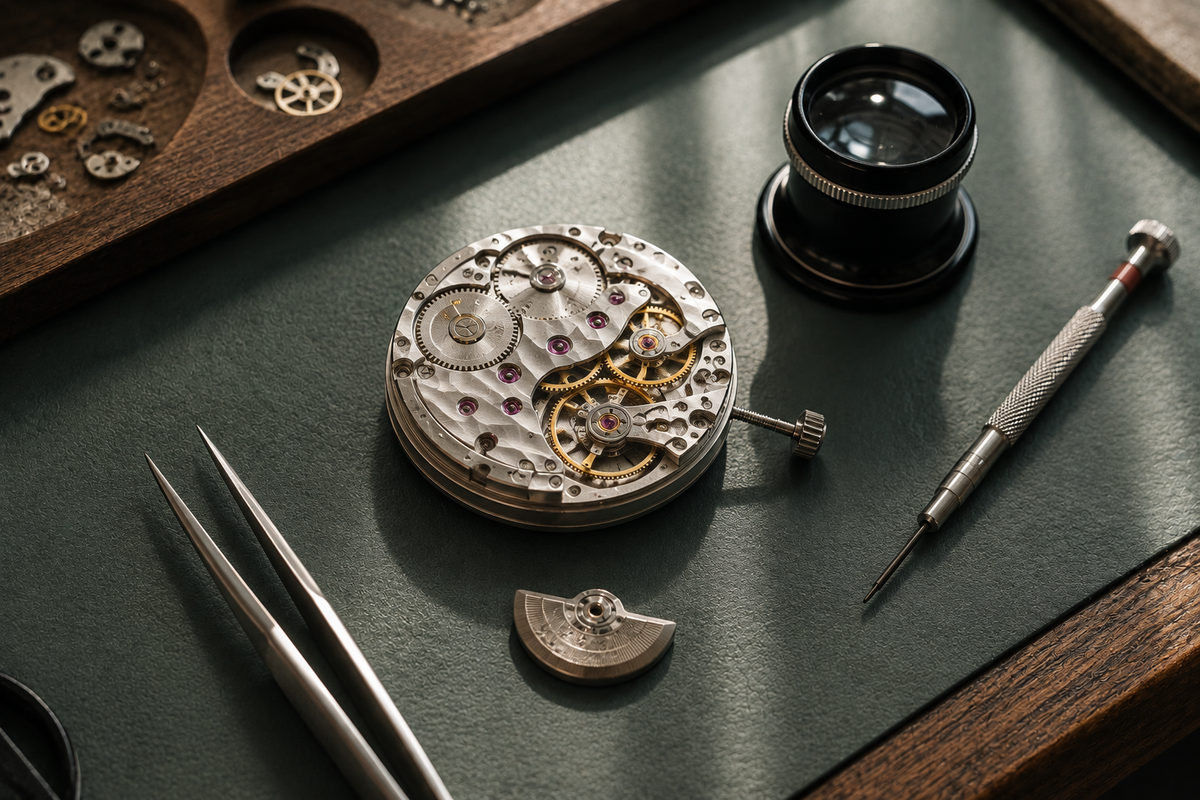
Hold a fine mechanical watch to your ear in a quiet room and you will hear a soft, rapid tick that owes nothing to batteries or circuitry. That sound comes from roughly 130 components, many smaller than a grain of rice, assembled by hand.
The question of how a mechanical watch works has fascinated collectors for centuries. A mechanical watch stores energy in a coiled spring, releases it in measured increments, and turns those increments into the sweep of hands across a dial. No electricity. Only physics, metallurgy, and patience.
The Parts of a Mechanical Watch, Explained

Every mechanical movement, from an entry-level Swiss caliber to a hand-finished masterpiece, shares the same architecture.
|
Component |
Function |
|
Mainspring |
Stores wound energy and sets power reserve |
|
Barrel |
Houses the spring, delivers even torque |
|
Gear train |
Transmits energy and reduces speed |
|
Escapement |
Releases energy in controlled increments |
|
Balance wheel |
Oscillates at a fixed frequency to keep time |
|
Jewels |
Reduce friction at pivot points |
|
Rotor |
Winds the spring through wrist motion (automatics only) |
Synthetic ruby jewels are not decorative. Set where metal pivots meet metal plates, they provide a hard, low-friction bearing surface. A typical automatic movement contains 21 to 30 of them.
How a Watch Mainspring Works: Storing the Energy
Everything begins with tension. The mainspring is a flat ribbon of hardened alloy coiled inside a barrel. Winding the crown tightens that ribbon, storing potential energy the way a drawn bow does. As it relaxes, it turns the barrel and drives the gear train.
The time a watch runs on a full wind is its power reserve:
- Standard three-hand movements: 38 to 48 hours
- Extended reserve calibers: 60 to 80 hours
- Twin-barrel movements: 8 days or more
A freshly wound spring pushes harder than one near the end of its reserve, and uneven torque produces uneven timekeeping. Watchmakers correct this through spring geometry and barrel design.
Watch Escapement Explained: The Heart of the Movement

If the mainspring is the fuel tank, the escapement is the metering system. Left unchecked, a mainspring would spend its energy in seconds. Most modern watches use the Swiss lever escapement, which cycles through three stages:
- Lock: The pallet fork holds the escape wheel still
- Impulse: The balance wheel nudges the fork and receives energy in return
- Release: The escape wheel advances one tooth, then locks again
The balance wheel oscillates on a hairspring, and its frequency sets the watch's rhythm.
|
Frequency (vph) |
Beats per Second |
Application |
|
18,000 |
5 |
Vintage movements |
|
21,600 |
6 |
Dress and heritage calibers |
|
28,800 |
8 |
Modern industry standard |
|
36,000 |
10 |
High-frequency chronometers |
Brands producing their own escapements, such as those in the Grand Seiko collection, often develop proprietary geometries for added precision.
Automatic vs Manual Watch Movement: Two Ways to Wind

Both share identical architecture from the barrel forward. Only the winding method differs.
|
Consideration |
Manual |
Automatic |
|
Winding method |
Crown, by hand |
Rotor, via wrist motion |
|
Case thickness |
Slimmer |
Slightly thicker |
|
Daily ritual |
Requires attention |
Largely self-sustaining |
|
Caseback view |
Unobstructed |
Rotor may cover movement |
Neither is superior. Collectors who value slimness prefer manual calibers, while those who wear one watch daily often choose automatics. Browsing the new watch arrivals is the best way to feel the difference.
Mechanical vs Quartz Watch: Understanding the Distinction

A quartz watch uses a battery to vibrate a crystal 32,768 times per second and counts those vibrations electronically.
|
Factor |
Mechanical |
Quartz |
|
Power source |
Wound mainspring |
Battery |
|
Accuracy |
4 to 6 seconds daily |
15 seconds monthly |
|
Components |
130 to 300+ |
50 to 100 |
|
Service |
Every 5 to 7 years |
Battery changes |
|
Seconds hand |
Smooth sweep |
One-second steps |
Quartz wins on accuracy. Mechanical wins on craftsmanship, serviceability, and tradition. Our guides to quartz versus automatic watches and how a quartz watch works cover the comparison in depth.
Craftsmanship: Why Fine Mechanical Watches Command Their Value

What separates a fine timepiece from a functional one is finishing, the hand-work applied to components most owners never see:
- Anglage: hand-beveled, mirror-polished edges on bridges and levers
- Côtes de Genève: rippled striping across bridges and rotors
- Perlage: overlapping circular graining on baseplates
- Black polishing: a surface that shifts between black and white by angle
- Hand-engraving: unique decorative work on balance cocks
None of this improves accuracy. Maisons such as Vacheron Constantin devote dozens of hours to a single movement because tradition holds that every component deserves care. It is also why a serviced movement from the 1960s still runs beautifully, making the pre-owned collection so compelling.
Mechanical Watch Maintenance: Protecting the Investment
Oils degrade, metal wears, and gaskets lose their seal. Regular servicing is why century-old watches still keep time.
|
Service |
Frequency |
|
Full movement service |
Every 5 to 7 years |
|
Water resistance test |
Annually |
|
Accuracy check |
Every 1 to 2 years |
|
Bracelet inspection |
Annually |
Simple habits extend movement life:
- Stop winding at the first resistance
- Keep timepieces away from magnets and laptops
- Avoid date changes between 9 p.m. and 3 a.m.
- Rinse after saltwater exposure, following proper steel bracelet cleaning practices
Battery-powered pieces follow a separate schedule, outlined in our guide on whether quartz watches need servicing.
Opening a case without proper tools risks contaminating the movement and compromising water resistance. The master watchmakers providing luxury watch service in Greenwich and New Canaan, CT at Manfredi Jewels work with factory-specified parts and calibrated timing equipment.
Bringing It All Together
A mechanical watch is an argument in favor of doing things the difficult way. Energy enters through a spring, travels through gears, meets an escapement that measures it into equal heartbeats, and emerges as hands sweeping across a dial.
Our specialists would be glad to walk you through a movement in person at either the Greenwich or New Canaan boutique. Schedule a visit with Manfredi Jewels and see the craft up close.
Frequently Asked Questions
How does a mechanical watch work without a battery?
A mechanical watch draws power from a wound mainspring rather than an electrical source. As the spring unwinds, it drives a gear train, and an escapement releases that energy in measured increments to move the hands. The system runs entirely on stored tension and controlled release.
How long does a mechanical watch last?
With servicing every 5 to 7 years, a quality mechanical watch can run for generations. Worn components are replaceable, and movements from the mid-20th century routinely return to specification after professional restoration. Longevity depends more on maintenance history than on age.
Are mechanical watches more accurate than quartz?
No. Quartz movements are considerably more accurate, typically within 15 seconds per month, while a certified mechanical chronometer runs within 4 to 6 seconds per day. Collectors choose mechanical watches for craftsmanship and tradition rather than raw precision.
Do automatic watches need to be wound manually?
Not usually, provided you wear them regularly. If an automatic has stopped or has been unworn for several days, wind the crown 20 to 30 turns before setting the time. Normal wrist motion keeps the mainspring charged after that.
What happens if you overwind a mechanical watch?
Modern automatic movements include a slipping clutch that prevents overwinding entirely. Manual-wind watches can be overwound, so stop at the first firm resistance. If a crown feels unusually stiff or free-spinning, have a watchmaker inspect it.
How much does it cost to service a mechanical watch?
Costs vary by movement complexity, brand, and parts required. A standard three-hand service falls in a moderate range, while chronographs and perpetual calendars cost considerably more. An authorized service center can provide a firm estimate after inspection.